◉
Multimodal models got good enough
Vision-language models are finally reliable enough to turn a raw frame into an evidence-backed memory — not just a caption.
MEMO gives AI glasses a memory of the physical world, without recording your whole day.
We’re building a visual memory layer for AI glasses — with adults and older adults as our first market.
The problem
As people age, small everyday memory lapses — where did I put this, did I already do that, what happened earlier — get more frequent, and more disruptive. The people who’d normally help, adult children and other family, aren’t always there when the question comes up.
Today’s AI glasses can see and answer in the moment, but that isn’t the same as a memory. Once the moment passes, there’s no trustworthy record to check later, and no easy way to bring a trusted person in when it calls for more than a quick answer.
MEMO
Tap a card to see how it actually works.
Evidence, not footage
Confirmed sightings of real objects and places become a durable, queryable memory — built from bounded evidence, not a video archive.
Tap to see how it works ↻
How it works
A confirmed sighting becomes a durable memory, with its evidence attached — not a video file.
Human in the loop
When judgment matters more than an automated answer, MEMO opens a live call to a trusted person, seeing what the wearer sees.
Tap to see how it works ↻
How it works
One request opens a live call so a trusted person can see and hear what the wearer does.
Hands-free, glasses-native
Everyday questions, answered locally, without pulling out a phone or repeating context the system should already have.
Tap to see how it works ↻
How it works
No cloud round-trip — the question is heard, reasoned over, and answered on the same local hardware.
How it works
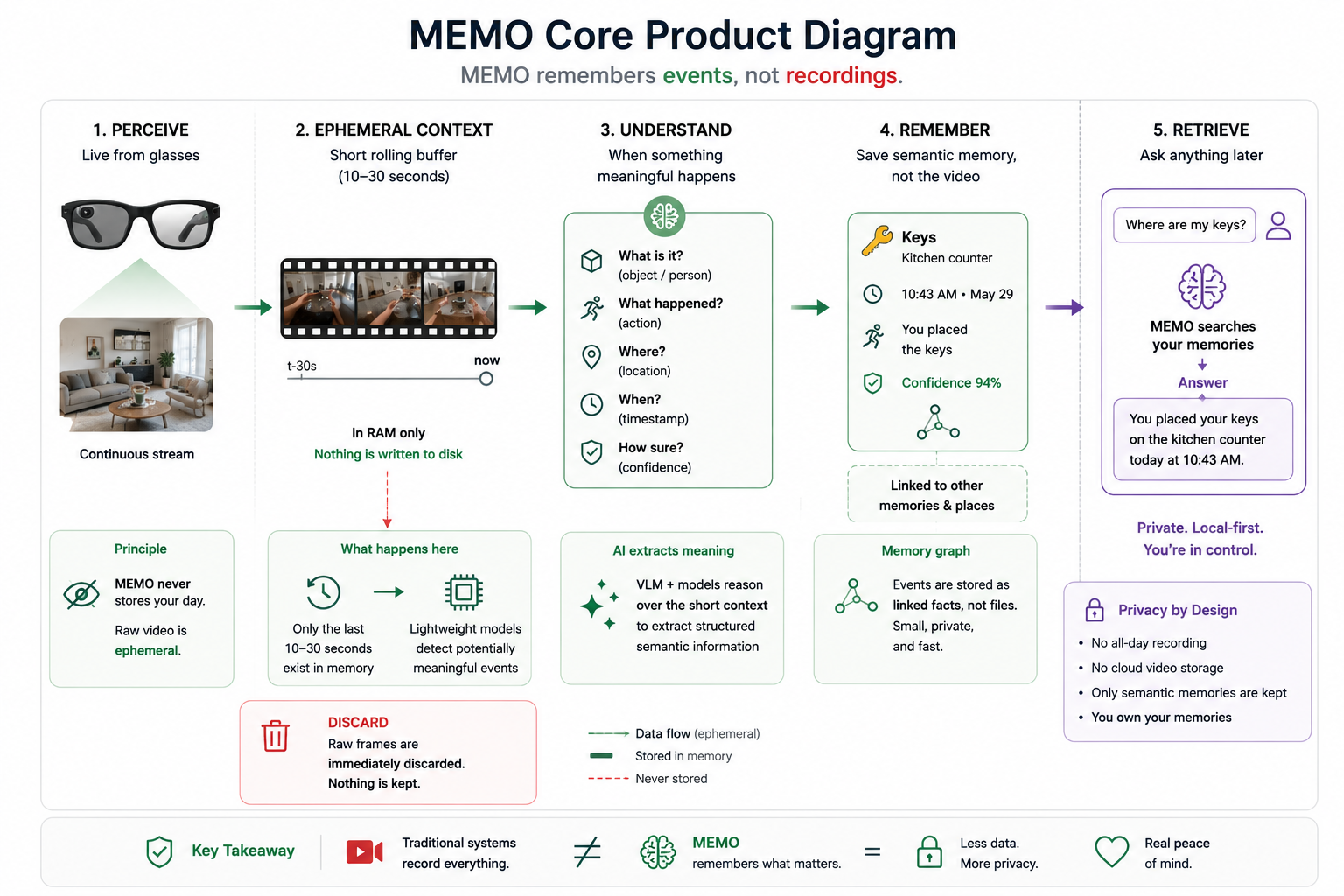
MEMO doesn’t record continuously. A meaningful event triggers a short capture, a model turns that capture into an evidence-backed memory, and later a question retrieves it — with the evidence to back it up.
Privacy thesis
A useful memory does not require continuous recording. MEMO’s premise is that a short, bounded clip of a confirmed event is enough to make an answer trustworthy — and that anything beyond that evidence window is a liability, not a feature. No rolling video of your day, no footage of the people around you, no record kept because it might someday be useful.
Why now
Vision-language models are finally reliable enough to turn a raw frame into an evidence-backed memory — not just a caption.
Camera-equipped glasses like the RayNeo X3 Pro are light and unobtrusive enough for daily use, not just a demo.
Compact local hardware, such as the Acer GN100, can now run perception, speech, and reasoning together, without sending anything to the cloud.
The thesis
Today’s assistants mostly reason over the present moment. A wearable assistant becomes substantially more useful when it can remember the physical world over time. MEMO is building that memory layer:
Not just an interesting smart-glasses app for older adults — a visual memory layer for wearable AI, with older adults as the first market.
What exists today
MEMO runs end to end today, on real hardware, in public.
RayNeo X3 Pro glasses paired to a single Acer GN100, running perception, speech, reasoning, and memory entirely locally.
Winner, NVIDIA Spark Hackathon Seattle 2026, judged on a live, working system.
A recorded demo and a live in-person walkthrough are both available on request.
The current prototype runs locally, keeping visual and personal context on local hardware.
Where we start
MEMO starts with adults and older adults who want help remembering everyday things, staying connected to family, and getting contextual assistance through smart glasses.
“Where did I leave my keys?” “Did I already do this?” “What happened earlier?”
Call a family member or caregiver directly from the glasses when help is needed.
Ask what to cook, what an object is, what to do next, or get contextual guidance.
MEMO is not designed to continuously record a person’s life. It creates selective, evidence-based memories when useful events occur.
Who might pay
One hypothesis is that the wearer is the user while an adult child or family member may be the buyer. If that holds, it would matter for the business model — but like the questions below, it’s untested.
What we need to validate
Is the memory and connection gap we’re solving actually a top-of-mind problem for older adults and their families, or a nice-to-have?
Does glasses-based use fit naturally into daily life, or does it add friction that outweighs the benefit?
Will a family pay for this, and at what price relative to what they already spend on care and safety tools?
Hardware, setup, and support — what does it take to actually get this into someone’s home and daily routine?
These are open questions, not results. We have not run paid pilots, signed customers, or generated revenue — and won’t claim otherwise.
Roadmap
The team
Reach any of us directly to learn more.
Message any of us directly about what we are building.
Investors & partners
If evidence-based visual memory for older adults, their families, and the care organizations that support them is interesting to you, we’d like to talk.